


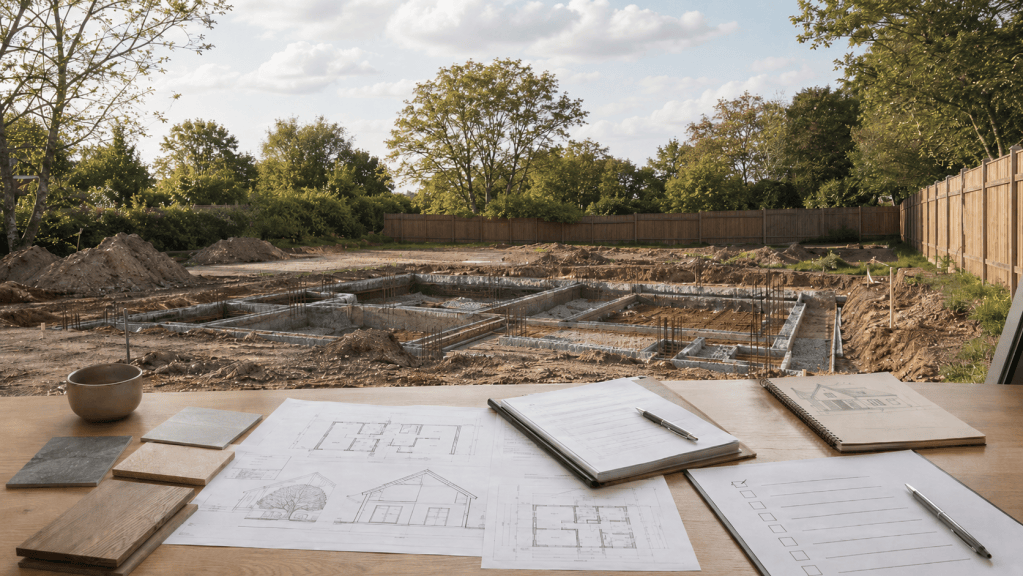
Receiving planning permission is a major milestone on a self-build project, but the decision notice is rarely the end of the planning process. Most permissions come with conditions attached, and some of those conditions may need to be dealt with before any work can lawfully begin.
Understanding planning conditions for self-builds is therefore essential before you move from approval into construction. Starting too early, or assuming that a condition can be dealt with later, can create avoidable delays and may leave the project exposed to planning enforcement.
In this guide, we explain what planning conditions are, how to spot the important trigger points, what “commencement” means in practice, how conditions are discharged and what options may be available if a condition is unnecessary or needs to change.
What are planning conditions?
Planning conditions are requirements attached to a planning permission. They allow a local planning authority to approve a development while controlling particular details or stages of the project.
For example, a self-build permission might include conditions covering:
- external materials;
- finished floor or site levels;
- landscaping and boundary treatments;
- highway access and visibility;
- surface water or foul drainage;
- ecology or biodiversity measures;
- tree protection;
- construction management;
- archaeology;
- removal of permitted development rights;
- requirements that must be met before the home is occupied.
National policy in England says conditions should be kept to a minimum and should only be imposed where they are necessary, relevant to planning and to the development, enforceable, precise and reasonable.
Even so, a permission for a new dwelling can contain several conditions, and each one needs to be read carefully rather than treated as standard wording.
Not all planning conditions have the same trigger
One of the most useful things you can do when permission is granted is to go through the decision notice condition by condition and identify exactly when each requirement becomes relevant.
Conditions may apply:
- before any development begins;
- before particular works start;
- before above-ground construction;
- before occupation;
- within a specified period;
- throughout construction;
- permanently after completion.
The wording matters. A condition beginning “no development shall take place until…” is very different from one requiring details before occupation.
A simple condition schedule can help. List the condition number, what information is needed, who will prepare it, when it must be approved and whether a formal discharge application is required. That turns a long decision notice into a practical project checklist.
What is a pre-commencement condition?
A pre-commencement condition is one that must be satisfied before development starts. Government guidance gives wording such as “no development shall take place until…” or “prior to any works starting on site…” as typical examples.
These conditions deserve particular attention because carrying out development without complying with a pre-commencement condition can make that start unlawful and may lead to enforcement action.
National policy says pre-commencement conditions should be avoided unless there is a clear justification for requiring the information at that stage. In many cases, an applicant in England must also agree to the wording of a proposed pre-commencement condition before permission is granted, subject to the exceptions in the legislation and guidance.
If your planning officer proposes a pre-commencement condition before determining the application, it is worth considering the wording rather than agreeing automatically. Sometimes the required information can be provided before the decision, or the trigger can be framed more proportionately.
What counts as commencing a self-build?
This is where self-builders need to be especially careful.
Planning commencement is not simply the date on which the builder arrives, machinery is delivered or the project is marked as “started” in your programme. In planning law, commencement generally turns on carrying out a material operation that forms part of the approved development.
Depending on the permission and the work being undertaken, material operations can include activities such as demolition, digging foundation trenches, laying underground pipes or carrying out road works that form part of the development.
The crucial point is that carrying out something that might otherwise amount to a material start does not safely bypass an outstanding pre-commencement condition. If the permission says certain matters must be approved before development begins, deal with those requirements first and obtain the local planning authority’s written approval before crossing that trigger.
If there is any uncertainty about whether proposed enabling or site works could amount to commencement, take project-specific planning advice before proceeding.
How do you discharge a planning condition?
Where a condition requires further details to be approved, you normally submit those details to the local planning authority through an application for approval, commonly referred to as discharging the condition.
The submission should directly answer the wording of the condition. Depending on what is required, that might mean drawings, product information, reports, calculations, photographs, schedules or written specifications.
A single discharge application can cover several conditions from the same permission, which can be useful where the information is ready at the same time.
The Planning Portal’s guidance on discharging planning conditions explains the process and current application arrangements in England.
Planning Portal says local authorities should determine discharge applications within eight weeks of validation. That makes early preparation important. If your programme assumes foundations will start next month, waiting until the last moment to submit a pre-commencement drainage, ecology or materials condition can leave the site team ready to begin while the planning approval is still outstanding.
Do not treat submission as approval
Submitting the information is not the same as having the condition discharged.
If the condition requires details to be approved before a particular stage, the safest approach is to wait for the written decision confirming approval before moving beyond that stage.
This distinction is particularly important with pre-commencement conditions. A pending application does not automatically give you permission to start work.
Keep the discharge decision notices with the original planning permission and approved drawings. They form part of the planning record for the development and may be important later if the property is sold, refinanced or questions arise about whether the permission was implemented correctly.
What happens if you start work too early?
Starting before a required pre-commencement condition has been complied with can create a serious problem. Government guidance confirms that development carried out without complying with such a condition can be unlawful and may be subject to enforcement action.
The consequences will depend on the wording of the condition, what work has taken place and how the local planning authority responds. It is not sensible to assume that submitting the missing information retrospectively will automatically put matters right.
Local authorities have a range of enforcement powers, including action specifically relating to breaches of conditions. If work has already started and you discover that a pre-commencement requirement was outstanding, obtain planning advice promptly rather than simply carrying on.
Can a planning condition be changed or removed?
Yes, in some circumstances. A condition attached to a permission is not necessarily beyond challenge, but the correct route depends on what needs to change.
Before permission is issued
If a proposed condition is unnecessary, unclear or disproportionately restrictive, it may be possible to discuss alternative wording with the planning officer before the application is determined. This can be especially useful for proposed pre-commencement conditions.
Section 73
A section 73 application can be used to seek the removal or variation of a condition attached to an existing planning permission. The local authority considers the conditions relevant to the application and, if approved, issues a new permission alongside the original.
Non-material amendments
Where the change itself is genuinely non-material, a section 96A non-material amendment may sometimes be appropriate. Whether a change is non-material is a matter for the local planning authority to assess in the context of the particular permission.
There are also appeal routes in certain circumstances. If a condition is causing a genuine difficulty, establish the correct procedure before changing the approved scheme or ignoring the requirement.
A practical planning-condition checklist for self-builders
- Read the full decision notice. Do not focus only on the words “planning permission granted”.
- Separate the conditions by trigger. Identify pre-commencement, pre-construction, pre-occupation and ongoing requirements.
- Identify who needs to provide each item. This might be your designer, engineer, ecologist, drainage consultant, landscape designer or another specialist.
- Check the lead times. Specialist reports and local authority decisions can take weeks rather than days.
- Submit discharge applications early. Build the determination period into your construction programme.
- Answer the exact wording of the condition. Incomplete or unrelated information can lead to further queries.
- Wait for written approval where the trigger requires it. Do not assume submission alone is enough.
- Tell your builder which conditions affect site operations. The site team needs to understand what cannot happen yet.
- Keep a complete record. Save the original permission, discharge applications, approved details and decision notices together.
- Take advice before departing from the permission. A change may require a formal amendment rather than an informal agreement.
How HPD can help after planning permission
Planning conditions often create a second phase of design and coordination after permission has been granted. Some can be dealt with using information already prepared for the application, while others need new drawings, specifications or specialist reports.
If you are still approaching the application stage, our Planning Application Service can help with the preparation and submission of the planning application. Our Planning Resources are also available for self-builders who prefer to manage the process themselves.
Once permission is issued, review every condition before finalising the route into technical design and construction. Where a condition needs specialist input, allow time for that work before committing to a start date.
Final thoughts
Planning conditions for self-builds are not simply administrative notes added to the bottom of a permission. They form part of the approval and can control when work starts, what information must be agreed and how the completed development is used.
For self-builders, pre-commencement conditions deserve the closest attention. Identify them early, prepare the necessary information, allow time for the local authority to respond and obtain written approval before starting the relevant work.
A few hours spent organising the decision notice at the beginning of the post-planning stage can prevent weeks of uncertainty later and help the move from planning permission to construction run much more smoothly.