


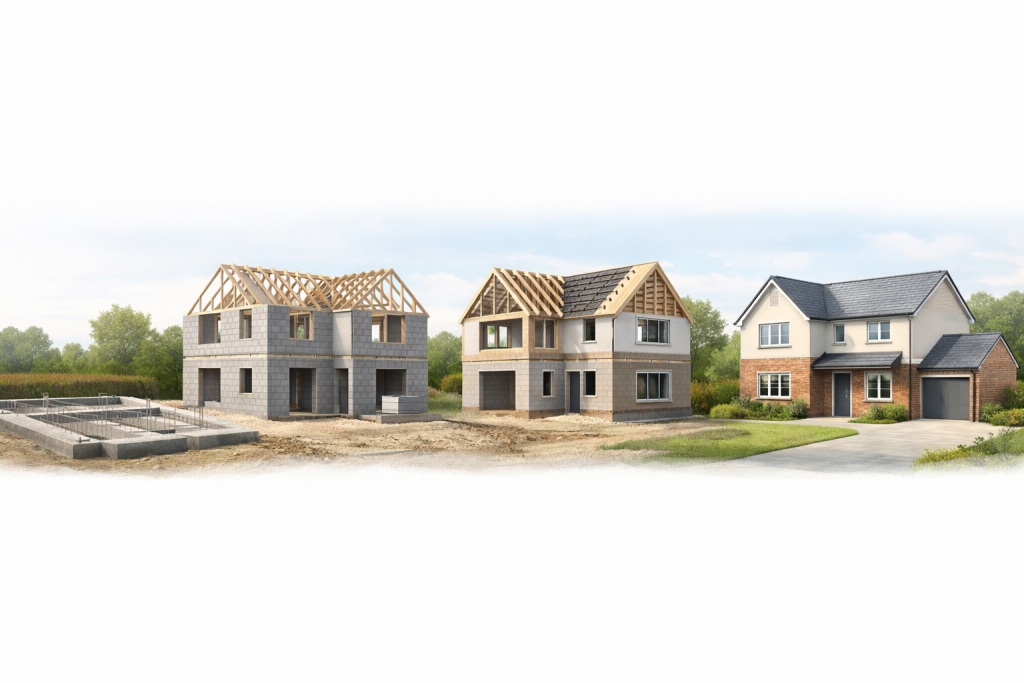
One of the most common questions we’re asked is:
“How long will it take to build our house?”
It’s a perfectly reasonable question — but the answer is rarely as simple as people hope.
In practice, there is a significant difference between the construction period and the overall project timeline. Understanding that distinction early can help avoid frustration and unrealistic expectations.
In this article, we’ll set out what a typical self-build timeline looks like in the UK, and where delays most often occur.
Construction time vs total project time
When people refer to “how long it takes to build a house”, they often mean the physical build period — from breaking ground to practical completion.
For a typical detached self-build home, that construction phase often takes:
- 7–10 months for a straightforward two-storey house
- 8–12 months where complexity increases
- Longer for larger or architecturally ambitious projects
However, this is only one part of the story.
The total project timeline usually includes:
- Early design and feasibility
- Planning permission
- Technical design and building regulations
- Tendering and contractor appointment
- Construction
- Completion and sign-off
From first concept to completion, many self-build projects take 18–30 months.
The typical self-build timeline (stage by stage)
1. Feasibility and early design
Often 2–4 months.
This stage includes:
- Establishing budget
- Reviewing planning context
- Developing initial layouts
Rushing this phase frequently leads to delays later.
2. Planning permission
Typically 3–6 months, sometimes longer.
While statutory determination periods exist, real-world timelines often extend due to:
- consultation responses
- requested amendments
- discharge of pre-commencement conditions
Planning can feel slow — but it is a critical stage.
3. Technical design and building regulations
Usually 2–4 months.
This stage translates planning drawings into:
- detailed construction drawings
- structural design
- specification
Shortcuts here can create site delays and cost overruns.
4. Tendering and contractor appointment
Often 1–3 months.
Allowing sufficient time to:
- obtain competitive pricing
- review specifications
- clarify scope
helps prevent later disputes.
5. Construction phase
Typically 7–12 months.
The exact duration depends on:
- weather (this is the UK, after all)
- complexity
- supply chain
- contractor organisation
- level of client decision-making during build
Projects with clear documentation and early decisions tend to progress more smoothly.
Where delays most often occur
In our experience, delays usually stem from:
- Late design changes
- Planning condition complications
- Service connection issues
- Weather during groundworks
- Specification upgrades introduced mid-build
Very rarely is delay caused by a single dramatic event. It is usually incremental.
The myth of the “12-month build”
We often hear people reference a “12-month timeline”.
While that can be realistic for the construction stage, it is rarely representative of the entire process.
A more measured expectation is:
- 6–12 months before breaking ground
- 7–12 months of construction
- Additional time for final approvals and occupation
Understanding this from the outset reduces stress considerably.
How to keep a project moving
There are several practical steps that improve programme certainty:
- Establishing realistic budgets early
- Designing with planning constraints in mind
- Completing technical information thoroughly before tender
- Avoiding frequent mid-build changes
- Setting clear expectations with contractors
Time efficiency is rarely about speed alone — it is about preparation.
Final thoughts
Every self-build project is unique, but the principle remains consistent:
The smoother the early stages, the more predictable the construction phase becomes.
Rather than asking only how long does it take to build a house, it is often more helpful to ask:
“How do we structure the project to avoid unnecessary delay?”
When that question is addressed properly, timelines tend to take care of themselves.