


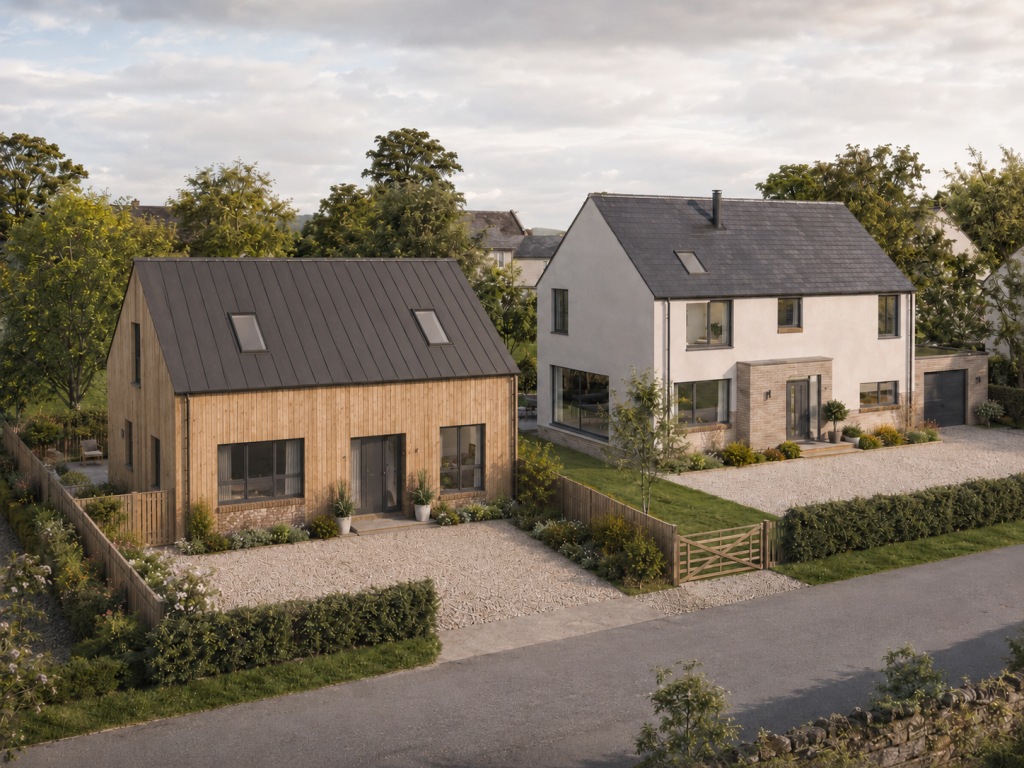
One of the earliest questions in a self-build project is also one of the hardest to answer:
How big should the house actually be?
For many people, the natural instinct is to maximise space wherever possible. But in practice, the “right” self build house size is rarely about building the largest house the plot or budget will allow.
Instead, it is about balancing:
- lifestyle
- budget
- long-term practicality
- and the realities of the site itself
Bigger isn’t always better
It is easy to assume that more space automatically means a better home.
However, larger houses also bring:
- higher construction costs
- increased heating and running costs
- more maintenance
- greater planning sensitivity
Well-designed homes are rarely defined purely by size, but by how effectively the space is used and how well the layout supports day-to-day living — principles that are increasingly recognised across the wider design industry
(more: Design Council).
Lifestyle should drive the design
The most successful self-build homes are usually designed around how people actually want to live.
Questions worth considering include:
- How much time is spent entertaining?
- Is open-plan living important?
- Will family needs change over time?
- Is single-storey living desirable in the long term?
A house that works well day-to-day often feels more spacious than one that is simply larger on paper.
Budget has a direct influence
Size is one of the biggest drivers of overall build cost.
Even relatively modest increases in floor area can have a noticeable impact once:
- foundations
- structure
- roofing
- glazing
- finishes
are all taken into account.
This is why establishing a realistic budget early is so important when defining the scale of a project.
The plot itself matters
The size and proportions of a plot will naturally influence what feels appropriate.
A large house on a constrained site can sometimes appear overdeveloped or dominate its surroundings, which may create planning challenges.
In contrast, a well-balanced design that responds appropriately to the site context is generally more successful both visually and in planning terms.
Think about future flexibility
It is also worth considering how the house may need to function in the future.
For example:
- children growing older
- working from home
- future accessibility needs
- ageing in place
Designing some flexibility into the layout can often be more valuable than simply increasing overall size.
Efficient design makes a difference
Well-designed homes tend to use space more effectively.
This can include:
- reducing unnecessary circulation space
- improving natural light
- creating multi-functional rooms
- improving the relationship between inside and outside space
A compact but carefully designed home can often feel far more generous than a much larger but inefficient layout.
There is no universal “ideal size”
One of the key things we’ve learned over the years is that there is no single correct answer.
The right size depends on:
- the people living there
- the plot
- the budget
- the priorities of the project
The goal is not necessarily to maximise square footage, but to create a home that feels balanced, comfortable and appropriate for the way it will actually be used.
Final thoughts
Choosing the self build house size is ultimately about understanding what matters most.
When lifestyle, budget and site constraints are all considered together, the result is usually a home that works better — not just during construction, but long after the project is complete.