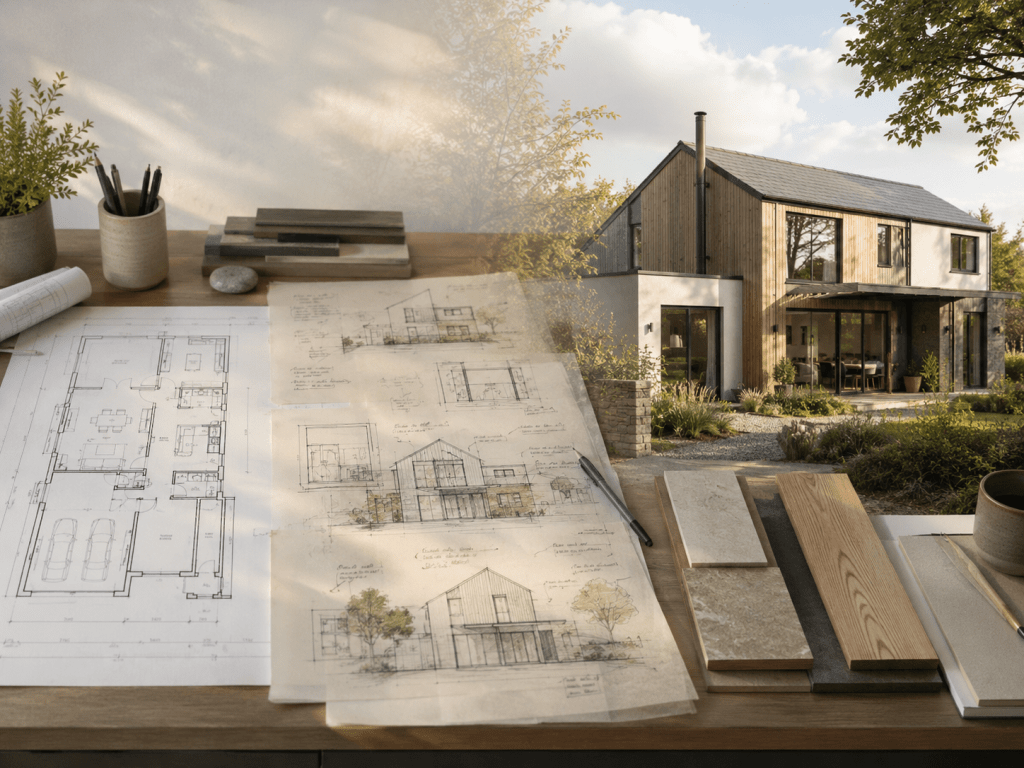
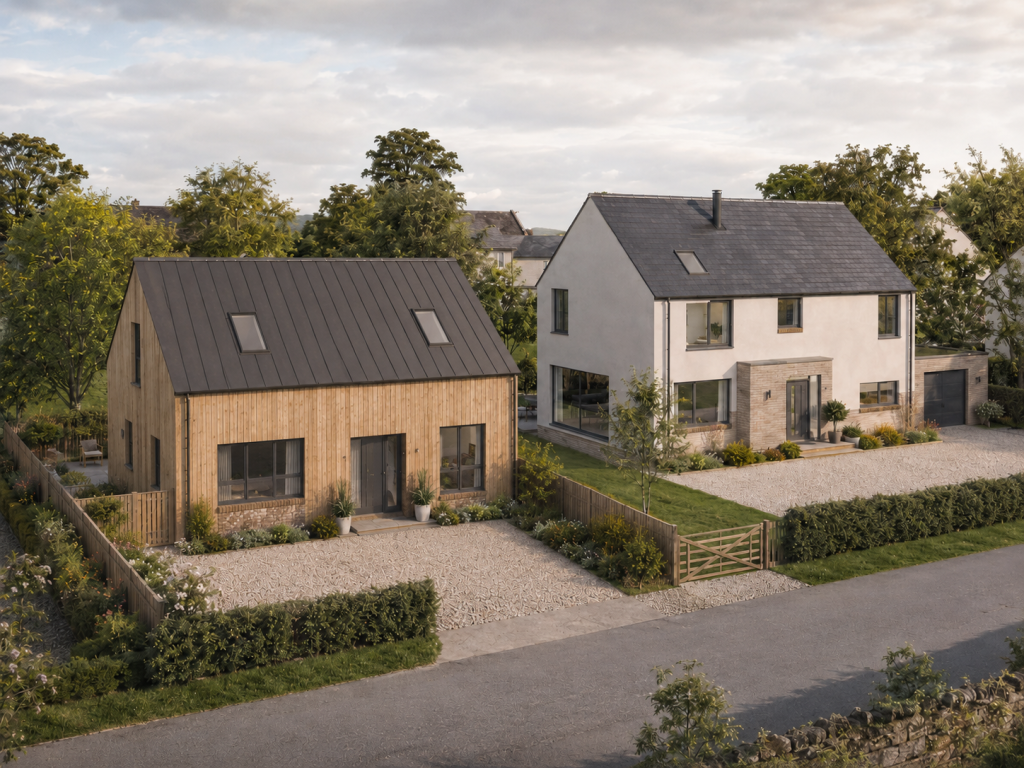
One of the most common early-stage questions we’re asked by self-build clients is some variation of: “How big should the rooms be?”
It’s an understandable concern. People want homes that feel generous, comfortable and future-proof — and most have spent months browsing floor plans online before speaking to a professional.
The challenge is that self build room sizes are often considered in isolation, without fully appreciating how they affect the overall footprint, cost, planning considerations and usability of a house. In this article, we’ll look at what tends to work well in practice, and where expectations can quietly start to cause problems.
Why room sizes are so easily misunderstood
Most people form their expectations by:
- comparing with their current home
- looking at new-build marketing plans
- browsing stock plans online
What’s often missing from that comparison is context:
- plot size
- total floorspace
- ceiling heights
- furniture layouts
- circulation space
A room that feels perfectly sized in one house can feel oversized — or inefficient — in another.
Bigger rooms don’t always mean better rooms
There’s a natural tendency to want to “add a bit more space” to key rooms, particularly:
- kitchens
- living rooms
- main bedrooms
Individually, those decisions often feel sensible. Collectively, they can:
- push the overall house size up quickly
- increase build cost disproportionately
- affect footprint and massing
- create planning issues on constrained plots
A well-proportioned room is usually more successful than a simply larger one.
Typical room size ranges that work well
While every project is different, the following broad ranges tend to work comfortably in practice for many self-build homes:
- Living room: 18–25 m²
- Kitchen / dining: 25–35 m² (depending on layout)
- Main bedroom: 12–16 m² (excluding ensuite)
- Double bedroom: 10–12 m²
- Single bedroom / study: 7–9 m²
These sizes generally allow for:
- sensible furniture layouts
- good circulation
- flexibility of use
Pushing significantly beyond these ranges doesn’t always add proportional benefit.
Circulation space is the silent budget-drain
One of the most overlooked aspects of room sizing is circulation.
Long corridors, oversized landings and awkward transitional spaces can:
- add considerable floor area
- increase build cost
- contribute little to daily living
Efficient circulation doesn’t feel cramped — it simply feels purposeful.
Many well-designed houses achieve a sense of space not by enlarging rooms, but by reducing wasted space between them.
Ceiling height matters more than floor area
Perceived spaciousness is influenced just as much by vertical proportion as by floor area.
Modest increases in ceiling height, vaulted spaces or well-placed glazing can:
- make rooms feel larger
- improve daylight
- reduce the need to oversize rooms
These decisions can often deliver better results than simply adding square metres.
Planning and footprint considerations
Room sizes don’t exist in isolation — they feed directly into:
- total floorspace
- building footprint
- ridge height
- proximity to boundaries
On tighter plots, incremental increases in room size can quickly create planning sensitivities, particularly where:
- neighbouring properties are close
- garden space is limited
- overall massing needs to be controlled
This is where early restraint often pays dividends later.
Where expectations most often go wrong
The most common issue we see is not that rooms are too small — it’s that everything is slightly too large.
A few extra square metres here and there can:
- push a house into a different cost bracket
- reduce flexibility elsewhere in the design
- introduce planning complications
Often, a modest rebalancing delivers a better overall outcome.
A practical way to approach room sizing
Many self-builders find it helpful to start with a well-considered reference design and assess how the rooms feel as a whole, rather than designing each space independently.
This approach:
- grounds expectations early
- highlights trade-offs clearly
- allows informed adjustments where they matter most
It also helps keep the project aligned with budget and planning constraints.
Final thoughts
There is no single “correct” room size, but there are self build room sizes that work more efficiently and comfortably in practice.
Good self-build design is rarely about maximising every room — it’s about achieving balance across the whole house.
When that balance is right, homes tend to feel more generous, not less.
Top tip: Looking at proven house designs can be a useful way of understanding how room sizes, circulation and overall scale work together before committing to a bespoke layout.