


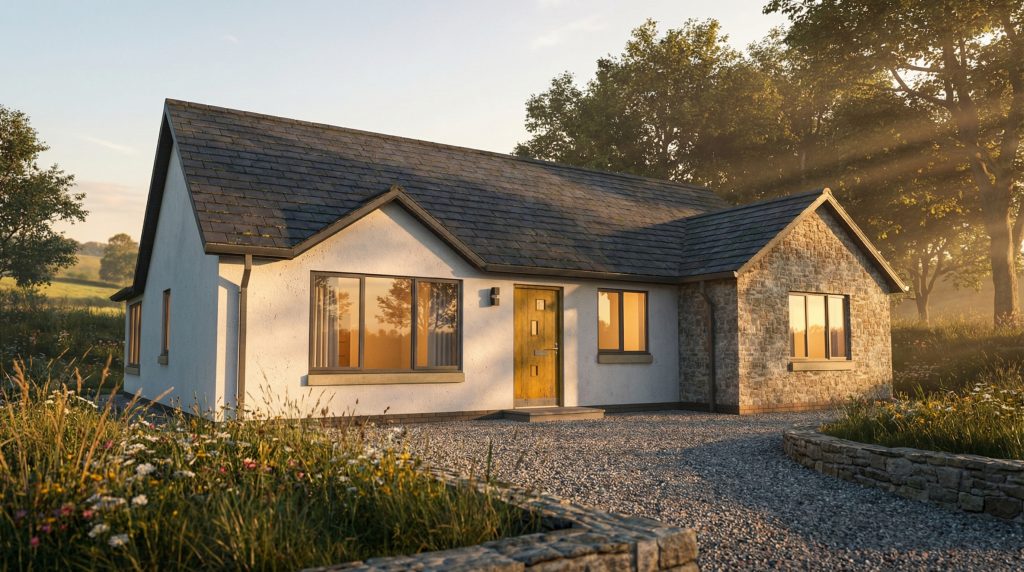
One of the earliest design decisions many self-builders face is whether to build a bungalow vs two storey house. It’s a choice that often feels intuitive — sometimes driven by lifestyle, sometimes by resale value, and often by an assumption about cost.
In practice, this decision is rarely as straightforward as it first appears. We regularly speak to clients who are surprised to discover that the option they assumed would be cheaper, simpler or easier to get through planning turns out not to be.
In this article, we’ll look at the real-world cost and planning implications of a bungalow vs two storey house, and why the “obvious” answer isn’t always the right one.
Why bungalows are often assumed to be cheaper
The logic is understandable. A bungalow:
- has no (or fewer) stairs
- feels simpler to construct
- is often associated with smaller homes
This leads many people to assume that a single-storey house must automatically cost less to build than a two-storey one.
In reality, build cost is driven far more by footprint and external envelope than by the number of storeys.
Footprint matters more than height
For a given amount of internal floor space, a bungalow almost always requires:
- a larger foundation area
- a greater roof area
- more external wall length
All three of these elements are among the most expensive parts of a build.
By contrast, a two-storey house:
- stacks accommodation vertically
- reduces foundation and roof area
- often achieves better efficiency per square metre
As a result, bungalows are frequently more expensive per square metre than equivalent two-storey homes.
Planning considerations: when each option helps (or hinders)
From a planning perspective, neither option is universally “easier”.
Bungalows can be advantageous where:
- ridge heights are tightly controlled
- overlooking is a concern
- neighbouring properties are single-storey
- visual impact needs to be minimised
However, their larger footprint can raise issues around:
- plot coverage
- proximity to boundaries
- impact on garden space
- landscape and character
Two-storey homes can be advantageous where:
- the plot is constrained
- a more compact form is preferred
- neighbouring context already includes two-storey buildings
But they may attract closer scrutiny in relation to:
- overlooking
- overshadowing
- massing and scale
The key point is that planning officers assess impact, not storeys, taking into account factors such as scale, massing and relationship to neighbouring properties (as reflected in national guidance on the Planning Portal).
Cost differences in practice
As a very general observation:
- A compact two-storey house often offers better build value
- A bungalow may command a premium due to footprint and roof complexity
That said, cost is rarely dictated by storeys alone. Factors such as:
- roof form
- glazing strategy
- specification level
- site conditions
can easily outweigh the basic bungalow vs two storey house question.
Accessibility, future-proofing and lifestyle
For many self-builders, particularly downsizers or those planning long-term occupation, bungalows remain highly attractive.
Single-storey living offers:
- easier accessibility
- reduced reliance on stairs
- flexibility for future needs
These benefits can justify a higher build cost if the house is intended to be a “forever home”.
Resale value: not always what people expect
Bungalows often command strong resale demand, particularly in certain areas. However:
- large bungalows can be expensive to build relative to resale uplift
- two-storey homes may offer better value where land prices are high
As with most self-build decisions, resale value should be considered — but not at the expense of buildability or planning risk.
Where expectations most often go wrong
The most common mistake is assuming that the choice between bungalow and two-storey is primarily a financial one.
In reality, it’s a balancing exercise between:
- site constraints
- planning context
- budget
- lifestyle priorities
Projects tend to run more smoothly when this decision is informed by the site and policy context first, rather than personal preference alone.
A practical way to approach the decision
Many self-builders find it helpful to explore both options at an early stage using well-considered house designs as reference points.
This allows:
- a clearer understanding of scale and footprint
- early identification of planning sensitivities
- more realistic cost comparisons
It also avoids committing too early to a route that later proves problematic.
Final thoughts
There’s no universal answer to whether a bungalow or a two-storey house is “better”. Each can be the right solution in the right context.
What matters is understanding how the choice affects cost, planning and deliverability before it becomes difficult or expensive to change direction.
Looking at proven house designs — both single and two-storey — can be a helpful way to compare footprint, layout and likely cost before committing too far down the line.