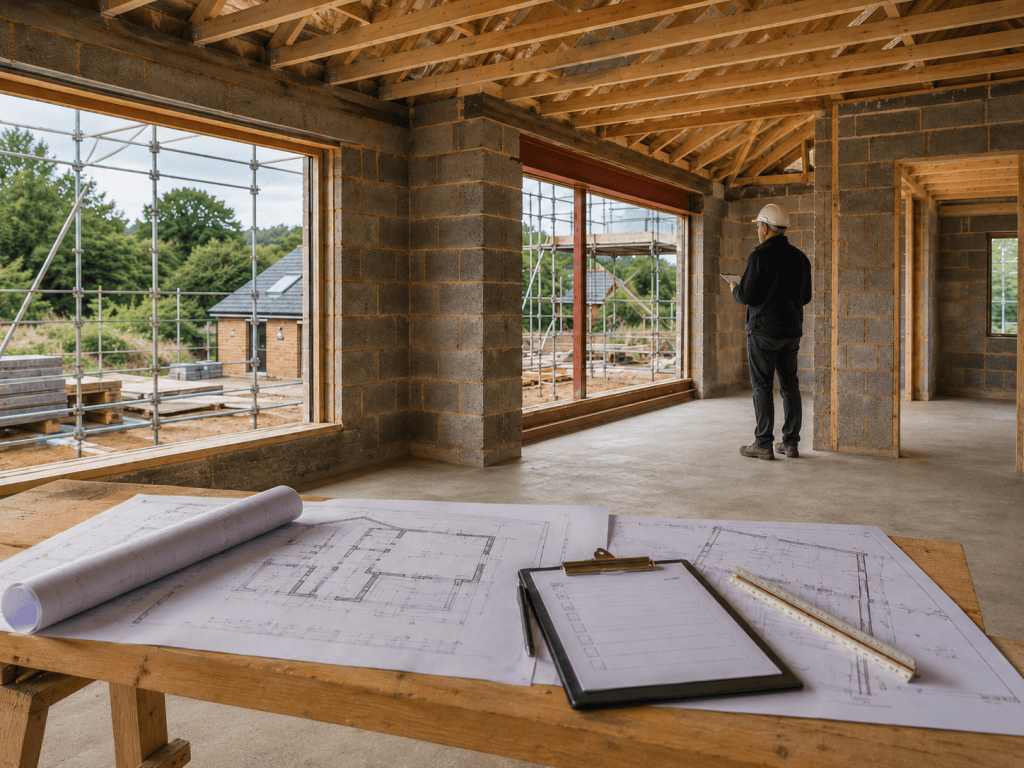
Finding the right plot is often the most challenging part of a self-build project.
Opportunities can feel limited, competition can be strong, and there is often pressure to make a decision quickly.
But the reality is that the plot you choose will have a greater influence on the success of the project than almost any other factor.
In this article, we’ll look at what to consider when assessing a self-build plot — and why taking a measured approach can save time, cost and frustration later on.
Planning potential is not always obvious
One of the most common misconceptions is that a plot’s potential is immediately clear.
In practice, planning suitability depends on a range of factors, including:
- local planning policy
- surrounding development
- site constraints
- planning history
A plot that appears ideal at first glance may carry hidden risks, while a less obvious site may have strong potential when assessed properly.
Access is critical
Access is one of the first things to consider.
Questions to ask include:
- Is there safe and suitable access to the site?
- Is visibility adequate?
- Will highways require improvements?
Access issues can be difficult — and sometimes impossible — to resolve later.
Services can significantly affect cost
It’s easy to focus on the purchase price of a plot, but the cost of connecting services can be substantial.
Consider:
- water supply
- electricity
- drainage (mains or private)
- broadband
Plots without existing connections may still be viable, but the implications should be understood early.
Site conditions matter
Ground conditions and topography can have a major impact on build cost and complexity.
Points to consider:
- slope of the site
- soil type
- potential for groundworks issues
- presence of trees or other constraints
Even relatively small changes in level can affect foundations and drainage.
Size and shape influence design
The size and shape of a plot will directly affect what can be built.
It’s not just about overall area, but:
- usable footprint
- setbacks and boundaries
- relationship to neighbouring properties
A well-proportioned plot will generally offer more flexibility than an awkward or constrained one.
Context is key
Planning decisions are heavily influenced by context.
Consider:
- neighbouring buildings
- street character
- density of development
- relationship to open countryside
A proposal that fits comfortably within its surroundings is far more likely to be supported.
The importance of having a reference design
As we discussed in a previous article, having a clear idea of the type of house you want to build can be extremely helpful when assessing a plot.
It allows you to ask:
- Can this site realistically support the scale of house we want?
- Will the layout work in this context?
- Does it align with our budget?
Without that reference point, it can be difficult to judge whether a plot is truly suitable.
Don’t rush the decision
Because plots are relatively scarce, there is often a temptation to move quickly.
However, taking time to:
- review constraints
- seek advice
- assess feasibility
can prevent costly mistakes.
The right plot will make the rest of the process significantly smoother.
Final thoughts
Choosing a self-build plot is not simply about finding a piece of land — it is about finding a site that supports the type of project you want to deliver.
When planning potential, access, services and context are all aligned, the project tends to progress with far fewer obstacles.
And in many cases, that early clarity makes all the difference.