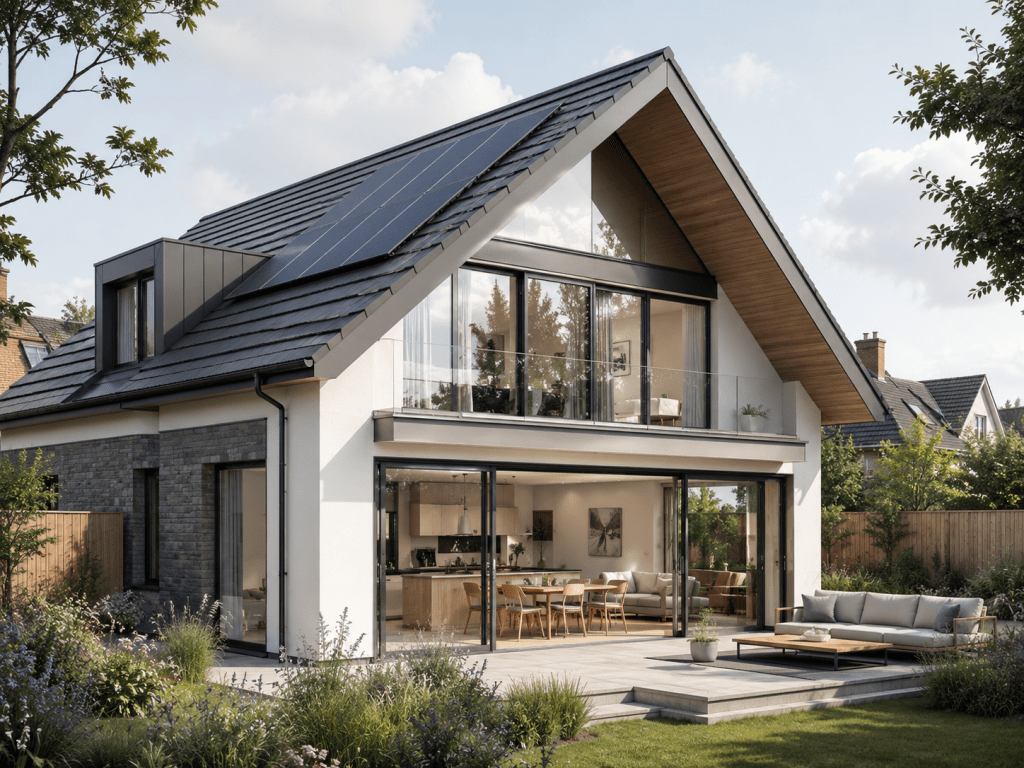
If you spend long enough helping people design their own home, certain patterns start to emerge.
Not trends or fashions, but something more consistent.
The same questions appear.
The same uncertainties arise.
And the same moments of clarity eventually follow.
After working with self-builders across the UK for the past eighteen years, those patterns have become familiar.
And they tell us something important about how people approach the process of building their own home.
After 18 years helping self-builders design their homes, certain patterns start to emerge. This short film reflects some of the lessons we’ve learned along the way.
Most people start with a feeling, not a brief
When people first begin exploring a self-build project, they rarely arrive with a perfectly defined brief.
Instead, they often begin with a feeling.
A sense of wanting something different from their current home.
A desire for more space, better light, or a different pace of living.
Alongside that feeling usually comes a degree of uncertainty.
Building a home is a significant commitment, and many of the decisions involved feel permanent. It is natural to worry about getting something wrong.
For many people considering a self-build, the process begins with research — often through guidance resources such as the Self Build Portal and other independent advice.
The same questions appear again and again
Over time we’ve noticed that many clients share similar early concerns:
- How big should the house be?
- What will the project realistically cost?
- How long will it take?
- Should the land or the design come first?
These are not architectural questions as much as decision-making questions.
They reflect the reality that self-build is as much about understanding priorities as it is about drawing plans.
Good design is rarely about perfection
Another pattern that becomes clear over time is that successful projects are rarely the result of chasing perfection.
Instead, they tend to emerge from clarity.
Clarity about:
- how the house will be used
- what matters most to the household
- which compromises are acceptable
Once those things are understood, design decisions become easier.
Experience helps with the order of decisions
One of the most valuable aspects of self build experience is not necessarily knowing every possible solution.
It is knowing which decisions matter first.
Many of the challenges that arise during self-build projects come from tackling questions in the wrong order.
For example:
- focusing on design before understanding budget
- buying land before considering realistic scale
- refining details before establishing the broader layout
When the sequence of decisions is right, the process tends to feel far more manageable.
The process becomes clearer over time
Every self-build project is different, but the underlying journey is often surprisingly similar.
People begin with a general idea of the life they want to create.
Through careful discussion, research and design development, that idea gradually becomes clearer and more defined.
Eventually, what once felt uncertain begins to feel achievable.
Experience isn’t about seeing everything
Eighteen years in business does not mean having seen every possible scenario.
The planning system evolves, construction techniques change and every site brings its own characteristics.
What self build experience does provide is perspective.
It helps identify the questions that matter most at the start of the journey, and the decisions that will have the greatest long-term impact.
Making the process feel possible
Building your own home will always involve important decisions.
But the right guidance does not make the process more complicated.
It helps make the path forward clearer.
And when the path becomes clearer, something important happens.
What once felt uncertain starts to feel possible.